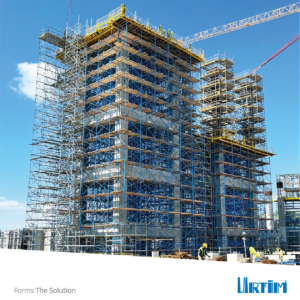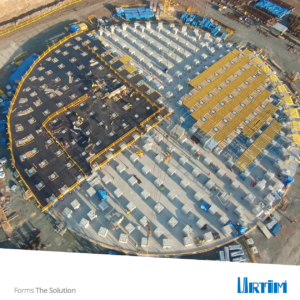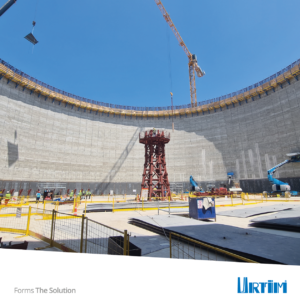
URTIM is proud to contribute to one of Türkiye’s strategic industrial investments through its advanced scaffolding and formwork solutions at the polyurethane facility in Ceyhan.
With our engineering expertise, reliable systems, and decades of experience, we continue to add value to large-scale and challenging industrial projects.
URTİM Chairman Serdar Urfalılar: DAPEK Is Emerging as the New Industrial Hub of the Eastern Mediterranean
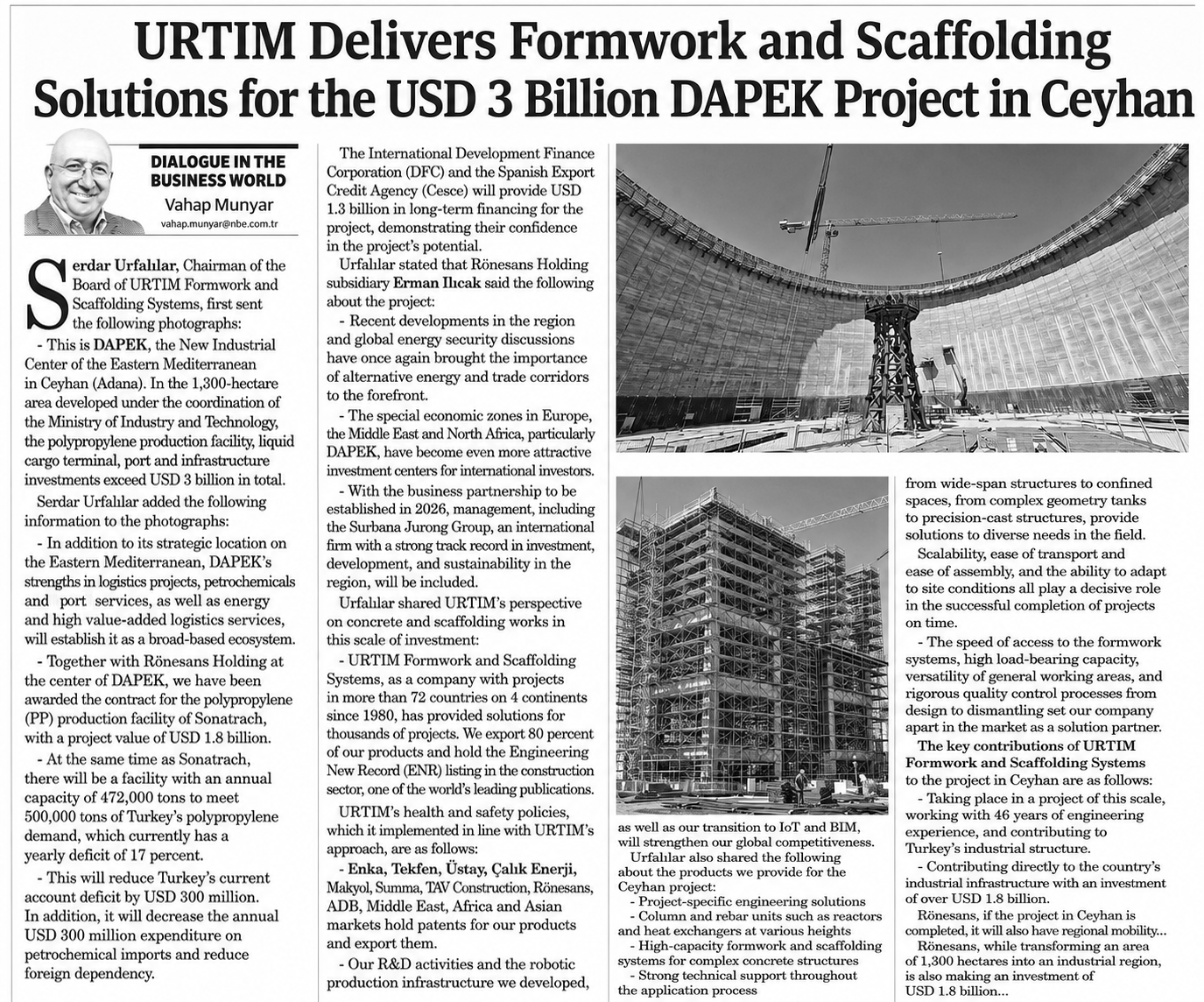
URTİM Formwork & Scaffolding Systems Chairman of the Board Serdar Urfalılar first shared photographs from the site:
“This is DAPEK in Ceyhan, Adana — the new industrial hub of the Eastern Mediterranean…”
Developed under the coordination of the Ministry of Industry and Technology across an area of 1,300 hectares, DAPEK encompasses investments exceeding USD 3 billion, including a polypropylene production facility, a liquid bulk terminal, a port, and extensive infrastructure investments.
Following the photographs, Serdar Urfalılar also shared additional information:
DAPEK, one of the most comprehensive industrial, energy, and logistics projects in the Eastern Mediterranean, brings together a broad ecosystem under one roof, extending from petrochemical production and port operations to energy infrastructure and logistics services.
At the heart of DAPEK is the USD 1.8 billion Polypropylene (PP) Production Facility, developed through a partnership between Rönesans Holding and Sonatrach.
Once completed, the facility — with Sonatrach also serving as the raw material supplier — will have an annual production capacity of 472,500 tons and is expected to meet 17% of Türkiye’s polypropylene demand.
This will contribute approximately USD 300 million annually to Türkiye’s current account balance by reducing imports by the same amount. In other words, Türkiye’s dependence on foreign sources in the petrochemical sector will be reduced further.
The information note shared by Urfalılar also included details of the investments currently underway at the site.
A liquid bulk terminal investment, developed through a partnership between Rönesans and Stolt Nielsen, is also progressing at the same location. The USD 1.3 billion financing secured from the U.S. International Development Finance Corporation (DFC) and the Spanish Export Credit Agency (CESCE) demonstrates the project’s global significance.
Urfalılar also shared remarks by Erman Ilıcak, Founder of Rönesans Holding, regarding the project:
“Recent developments in the Middle East and ongoing discussions surrounding global energy supply security have once again highlighted the importance of alternative energy and trade corridors.
Located at the intersection of the European, Middle Eastern, and North African markets, DAPEK is becoming increasingly attractive to international investors thanks to its strategic location.”
The development of the region was inspired by global industrial clustering models based on port, energy, and industrial integration, such as Rotterdam and Jurong Island in Singapore.
With a partnership initiated in 2026, Surbana Jurong Group became involved in the development process as a management partner, supporting investor development, international marketing, and sustainability initiatives.
Urfalılar stated that URTİM is providing the formwork and scaffolding infrastructure required for the concrete construction works at this large-scale industrial development.
“As URTİM Formwork & Scaffolding Systems, we have successfully completed more than 4,000 projects in 72 countries since 1980. With an export ratio of 80%, we are a supplier to many of the leading construction companies listed in Engineering News-Record (ENR).
Among the companies to which URTİM has supplied formwork and scaffolding systems are Enka, Tekfen, Üstay, Çalık Enerji, Makyol, Summa, TAV Construction, and Rönesans.
We export our patented products to markets across Europe, the United States, the Middle East, Africa, and Asia. Developed through our R&D capabilities and state-of-the-art robotic manufacturing infrastructure, our products fully meet international certification requirements, particularly European standards.”
Urfalılar then elaborated on URTİM’s involvement in the Ceyhan project:
“From engineering and design through to implementation, the entire process was managed by our own engineering team. Each structure within the facility was brought to life using individually designed formwork solutions tailored to its unique architectural characteristics.
From columns of varying heights, such as those used in reactor and heater units, to standard buildings with extensive shear walls; from construction works in confined areas with restricted access to the casting of tanks with special geometries, we developed solutions tailored to every specific requirement.
Our flexible approach, shaped according to variables such as height, load-bearing capacity, and site conditions, played a decisive role in ensuring the timely completion of the project.
In addition to formwork systems, URTİM also provided the site’s scaffolding requirements through a single-source solution, including vertical access, heavy-load support, general working areas, and scaffolding required for pipeline installation.”
URTİM Chairman of the Board Serdar Urfalılar emphasized the significance of URTİM’s involvement in the Ceyhan project:
“Being part of a project on the scale of DAPEK means directly contributing to Türkiye’s industrial infrastructure through our 46 years of engineering expertise and the experience we have gained internationally.”
After Rönesans eventually commenced the Ceyhan project, albeit with a delay, the region began to gain momentum.
While Rönesans is transforming the 1,300-hectare area into an industrial zone, it is also making a USD 1.8 billion investment in the region together with its partner.